
The Trauma Response
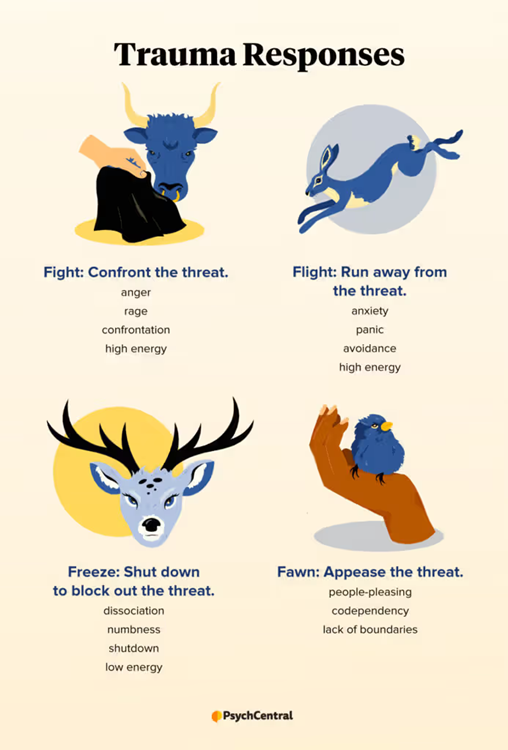
When a child or young person experiences trauma, the sympathetic nervous system is activated, releasing the stress hormones adrenaline and cortisol. These primary physiological changes are instinctual and survival in nature, preparing a child or young person to ‘fight or flight’ from a perceived threat. During these hormonal changes a child or young person’s heart rate will increase, digestion will slow down and legs will dilate to deal with the pending emergency.
If the child or young person is not capable of fighting or fleeing a traumatic situation, which is often true for very young children, the parasympathetic nervous system ‘freeze response’ is activated. According to Peter Levine (2008), what must be understood about the ‘freeze response’ is while the body looks still or lethargic, a full physiological stress response can be present within the person.
Fawning, another survival response, is characterised as a child or young person trying to please or appease others at the expense of their own needs. It is often a survival response strategy as a way to neutralise conflict. Children or young people engaging in a fawn response, may find it difficult to maintain healthy boundaries with others.
Trauma and memory
For trauma to properly store in the brain as a memory, it must go through a process called integration. Integration in the brain occurs when neurons in the cortex, limbic area and brain stem link effectively with one another. When trauma impacts neurological functioning different areas in the brain cannot link well, which effects integration.
Emotional memories are stored in the amygdala area of the brain, whereas day to day memories are stored in the hippocampus region in preparation for long-term storage. It is suggested that the hormonal surge in cortisol impacts the hippocampus ability to process and store day to day memories, contributing to difficulties with learning and memory. Emotional memories stored in the amygdala following a traumatic experience are often fragmented and unclear. Even after a significant passage of time, the stress response can feel as intense as if the trauma is occurring in the present time. For a child or young person, this may feel like an emotional highjack they cannot get out of, or an intermittent or persistent threat of danger.
Window of Tolerance
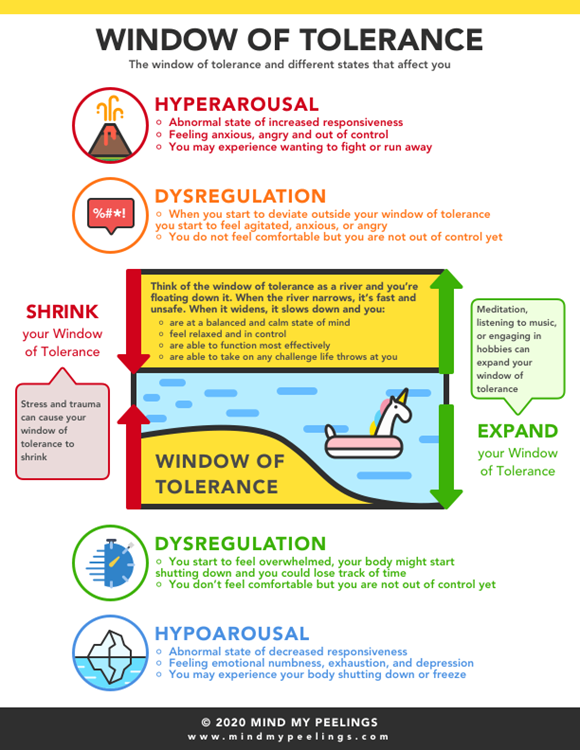
Dan Siegel uses the term ‘window of tolerance’ to describe a person’s optimal level of arousal to enable them to function in day-to-day life. When a child or young person is functioning within their window of tolerance, they can typically cope with whatever is happening in their life and function optimally for social participation and learning. When stress and trauma shrink a child or young person’s window of tolerance, it doesn’t take much for them to move into a dysregulated state. Fight, flight (hyperarousal) freeze and fawn (hypoarousal) all occur outside of a child or young person’s window of tolerance. For more information on the ‘Window of Tolerance’ see video below from Beacon House.
Read previous: ← Support for Trauma & PTSD